Case Study
Safe Cycling Ireland
This project aims to identify the safety challenges faced by the current cyclists on Irish roads and also exploring the barriers to adopting cycling as a means of transport in Ireland. Using the ethnographic research and design thinking to craft design solutions that can make a positive impact on overall cycling safety and promotion in ireland with the help of National transport authority ireland.
- Client
- Research Lab MU + National Transport Authority
- Role
- Leading UX Design & Research
- Duration
- Independent UX project
- Team
- Independent
- Platform
- Mobile Application · Civic / Public Sector
The problem
According to my research findings, most of the cyclists feel unsafe while sharing a road with other big vehicles, As they don't have a proper cycling infrastructure in Ireland. The existing cycling infrastructure is inefficient and poorly maintained, which seems more dangerous to ride on when compared to the main traffic and as a result of this they are forced to cycle in heavy traffic by putting their lives at a higher risk.
Approach
- 01Conducting research (qualitative and quantitative)
- 02Collecting insights to inform any design decision
- 03Proposing a solution and Designing UX+UI for the proposed solution.
- 04Testing it with real users and getting feedback for any further improvements.
At a glance
Project snapshot
Client
Research Lab MU + National Transport Authority
Tools Used
Multiple for research + Sketch + invision for design
Deliverables
Research findings + Solution plan
My Role
Leading UX Design & Research
The problem
Problem Statement
According to my research findings, most of the cyclists feel unsafe while sharing a road with other big vehicles, As they don't have a proper cycling infrastructure in Ireland. The existing cycling infrastructure is inefficient and poorly maintained, which seems more dangerous to ride on when compared to the main traffic and as a result of this they are forced to cycle in heavy traffic by putting their lives at a higher risk.
Who it's for
Users & Stakeholders
- Cyclists
- Transport authority team
- Other road users
Personas
Here are the two persona created representing these two user groups to understand their needs, motivations and pain point.
User Journey
User Journey Map
Mapping out the cyclist's end-to-end journey to surface emotional highs and lows, key touchpoints, and the moments where safety concerns surface most strongly.
My role
Roles & Responsibilities
This is an independent user experience design project and my key responsibilities included:
- Conducting research (qualitative and quantitative)
- Collecting insights to inform any design decision
- Proposing a solution and Designing UX+UI for the proposed solution.
- Testing it with real users and getting feedback for any further improvements.
Constraints
Scope & Constraints
- limited time and low budget
- Getting transport authority people onboard
- Finding right participants
Approach
Design Process
For this project I have used on the five-stage Design Thinking model proposed by the Hasso-Plattner Institute of Design at Stanford (d.school).
Research
Semi structured Interviews
All the interviews were recorded and transcribed.
Semi-structured interviews are often used for qualitative research, for this I prepared a topic guide with various topics covering cycling safety, cycling environment, the overall experience of sharing traffic. Mostly the questions asked were open-ended, to let the interviewee guide me through their knowledge and experience of that topic. Topic guide mainly included:
- Demographics
- Decision Making
- Bike Riding Experience
- Safety
- Area of Improvement
Research
Ethnographic Observations
Also did some observation around Dublin city for understanding the overall cycling environment and how cyclists interact with other road users. Observation is an excellent method for finding key insights, as you are in a natural setting and watching the actual event happening in front of you. My observation on Dublin roads gave me a clear picture of the cyclist and drivers actions while sharing the roads. And also, the inadequate cycling infrastructure.
Research
Survey
This survey was designed on the basis of the insights from the primary research, I reached out to few people i interviewed earlier and 10 different facebook pages, surprisingly i got a huge response of 80 people on this survey and people were very supportive. Two of groups named 'Dublin cycling campaign and I love cycling' put it on their twitter handle and shared it with all their members, which was very helpful.
Key insight
Lack of cycling infrastructure
Cyclist put themselves at higher risk while cycling in the middle of the traffic, Majority of the cyclist fatalities on the road are caused because of the collision between cars and cycles. Most of the Cyclists feel unsafe while sharing a road with other big vehicles, As they don't have any proper cycling infrastructure available, the existing cycling infrastructure is inefficient and poorly maintained, which seems a more dangerous to ride on in comparison to the main traffic , and as a result of this they are forced to cycle in heavy traffic. And putting their lives at a higher risk.
Framing
How might we help?
The question here is "How might we help transport authority to build a better environment and maintain the existing cycling infrastructure in Ireland?" For understanding the real problems faced by cyclist we need better data to inform transport authority's decision.
Solution
Solution Space
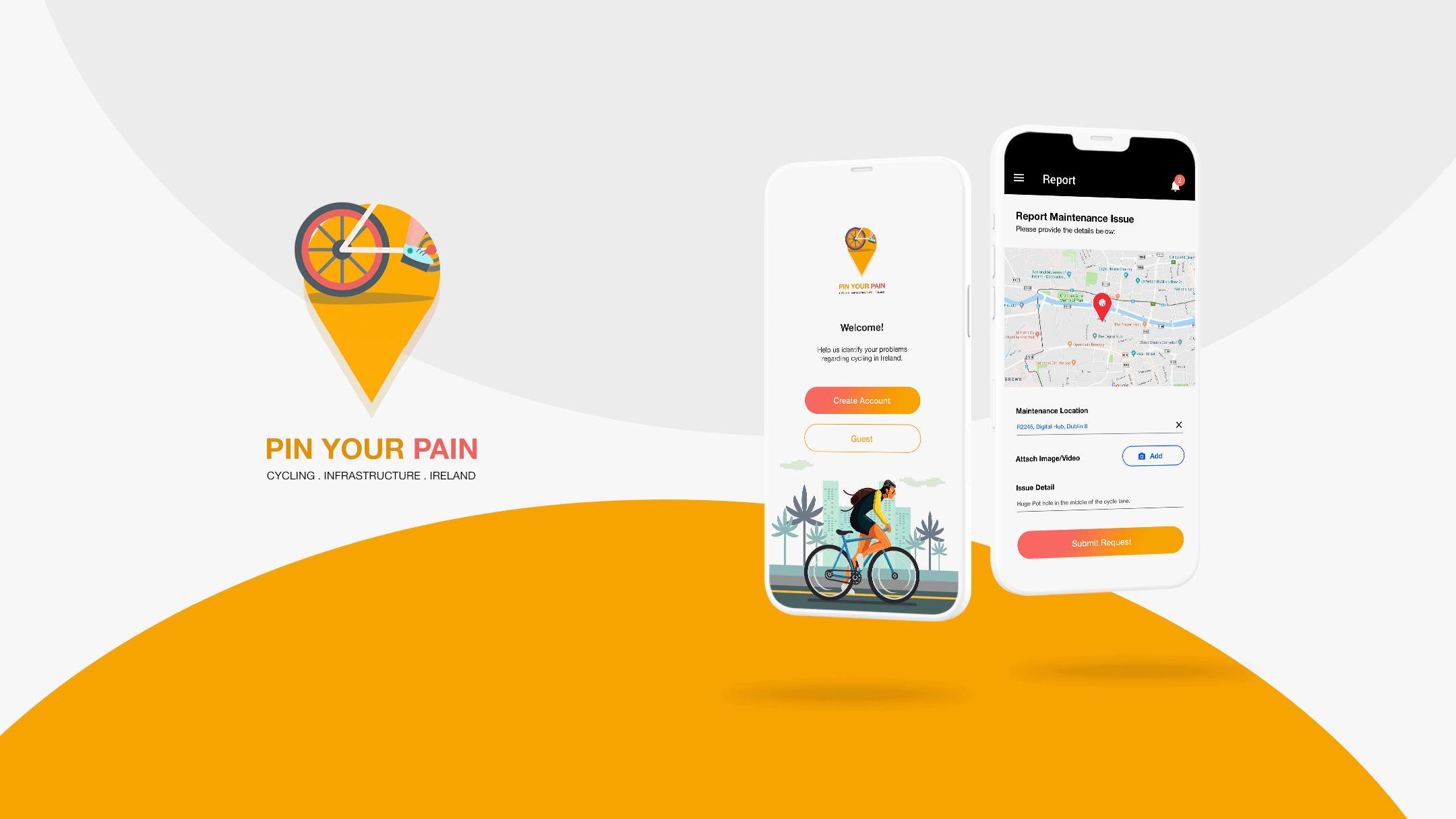
A geotagging mobile application for collecting data and information on the problems faced by the cyclists on the road. Mainly focusing on infrastructural challenges and recognising dangerous areas for cyclist and identifying reasons.
Features
The application will have options like;
These reports will be checked and solved in a timely manner by the Ireland transport authority. This could be helpful in getting data on the small injuries which go unreported all the time by understanding the area of the incident, the authority can decide on solving that particular area problem. The suggestion forum will be open for everyone to give their solutions to the existing problems and take feedback from other cyclists.
- Report a maintenance issue
- Report injury and a open suggestion forum.
- The user will able to pin any location with the details and image/video of that place.
Impact
Benefits
- It will help the transport authority to get informed of the challenges faced by the cyclist in Ireland, which they can use for improving it.
- Currently, people use social media to express the problem they face, which rarely get noticed, this application will be focusing on solving these problems in a measurable period of time.
- People can see their report status online. Which will help them in getting informed of the process. People will be able to see the dangerous routes pined most of the time and can choose another route for cycling.
Rationale
Reasons to Believe:
- From the research, I have found out that there is a lack of maintenance and proper infrastructure for cycling in Ireland.
- For solving this problem, we need better data to understand the problem clearly, and then we can address it more efficiently.
- It could be a small thing for authority but could be really important that they don't know about. e.g. cycling on a metal manhole cover. Which become slippery when it's wet and can cause injury, but it doesn't seem like a huge problem to be noticed because we don't have any data or number backing it.
- There are a lot of small things that need to be fixed to make Ireland a safe cycling country. The more information authority will get, the more accurate they will be in solving it.
Reflection
Learnings
"If I had only one hour to solve a problem, I would spend up to two-thirds of that hour in attempting to define what the problem is." — Head of the Industrial Engineering Department of Yale University
- It is challenging to pick only one actionable insight when you have found multiple.
- Finding 'why' people do in what they do is the most important part the process. we generally know the what but it takes a while to figure out why.